2. Stamping die cost high and the material utilization rate is low.
3. Single-process molds occupy equipment and personnel and have low efficiency.
4. The transfer system of the transfer die needs to be customized and integrated with the machine tool, which leads to a low utilization rate of the machine tool.
5. The cost of labor is increasing rapidly, so it is necessary to achieve automation or semi-automation as much as possible.
Transfer system
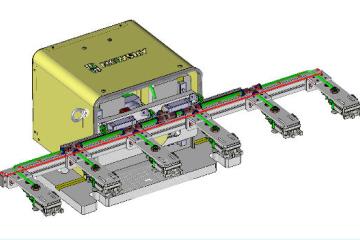
Tranfer system – A method that can be applied to various molds and reduce mold costs.
Simplify the mold to reduce the mold cost – The die is designed as a single-process die, but its efficiency is equivalent to that of a progressive die.
The transmission system can be installed on the T-shaped grooves of 60T to 500T presses and can be disassembled and installed at any time.
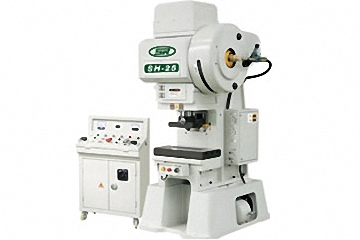
Mini press machine
For very small terminals, spring contacts and connector products, if equipment with a tonnage of over 30T is used, there may be an excess of punching force, and the mold cost will be high. Our idea is to design and produce a mini stamping machine with a punching force of 3 to 10 tons, which can be placed on a desktop and is suitable for use in factories on the second floor or above. This can reduce production area costs, electricity costs, and so on.
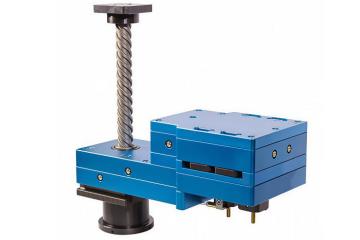
In die tapping machine
The product forming equipment uses the sliding motion of the press slide to drive the screw-gear mechanism, converting the up-and-down reciprocating motion into the helical motion of the tap. The extrusion tap is used for chipless processing. The transmission structure includes the screw assembly and the tapping component, which is equipped with up-and-down protection devices to prevent deviation of the hole position and damage to the equipment.
Collaborate with customers to develop
Collaborate with the clients to develop the project, including custom equipment, molds, and automated equipment, etc.
1. The client provides the project topic and objectives.
2. Our engineers analyze the customer’s requirements and formulate solutions.
3. Propose a manufacturing feasibility plan and start the design process.
4. Customer confirms the design plan
5. Project detailed design, manufacturing and testing.
5. Provide samples, conduct data analysis and size analysis, and formulate the next plan.